

Video: Animated paper-cutout art, created by Google Flow, prompts by Claude AI, music by Suno AI.
Who was the pilot?
We’ve had a strange smoke-filled summer in the Puget Sound area, but that didn’t stop our yearly Seafair celebration last weekend, which ended the way it always ends, with an airshow featuring the Blue Angels. That’s the U. S. Navy’s demonstration squadron. Six jets flying closer together than seems advisable.
As I watched, Uncle Ozzie came to mind. He flew these same skies in the mid-fifties as a Boeing test pilot.
Oscar Elmer Olson Jr. enlisted in Portland, Oregon, on November 30, 1942, nine days shy of his twentieth birthday. He flew B-25s over the Mediterranean during WWII and came home with an Air Medal. In 1946 he bought himself a surplus twin-engine Cessna. Later he purchased an AT-6 out in Vale, in eastern Oregon, where he taught the local doctor to fly so he could reach patients in remote areas.
I never met Ozzie. He died before I was born. But his brothers and sisters thought he hung the moon, so naturally I think so too.
When he was a boy, Ozzie and his brother Jimmy wanted candy and had no money, so they sold their sisters’ dresses to the ragman. Truth. My aunt told me that story probably twenty times over the years. (And yet, she still adored him.)
My favorite Ozzie story relates to his antics a few years before he moved to Seattle, back in Portland. Or as we often call it, “Bridge City”.
On the morning of June 20, 1950, somebody flew a light plane under the Ross Island Bridge. The bridge tender saw it go under and disappear, decided it had gone in the river, and called the police. Both papers wrote it up. Neither one printed the pilot’s name. But Ozzie showed the article to his sister and let her know, “That was me!” She kept it in her keepsake box, and her daughter found it there years later.
A follow-up article quotes Art Woody, the supervisor of the mosquito control division, who explained that flying under the bridge is protocol. The island needed spraying, and there is a flock of wires overhead, so going under is the only way to get to the island on the other side.
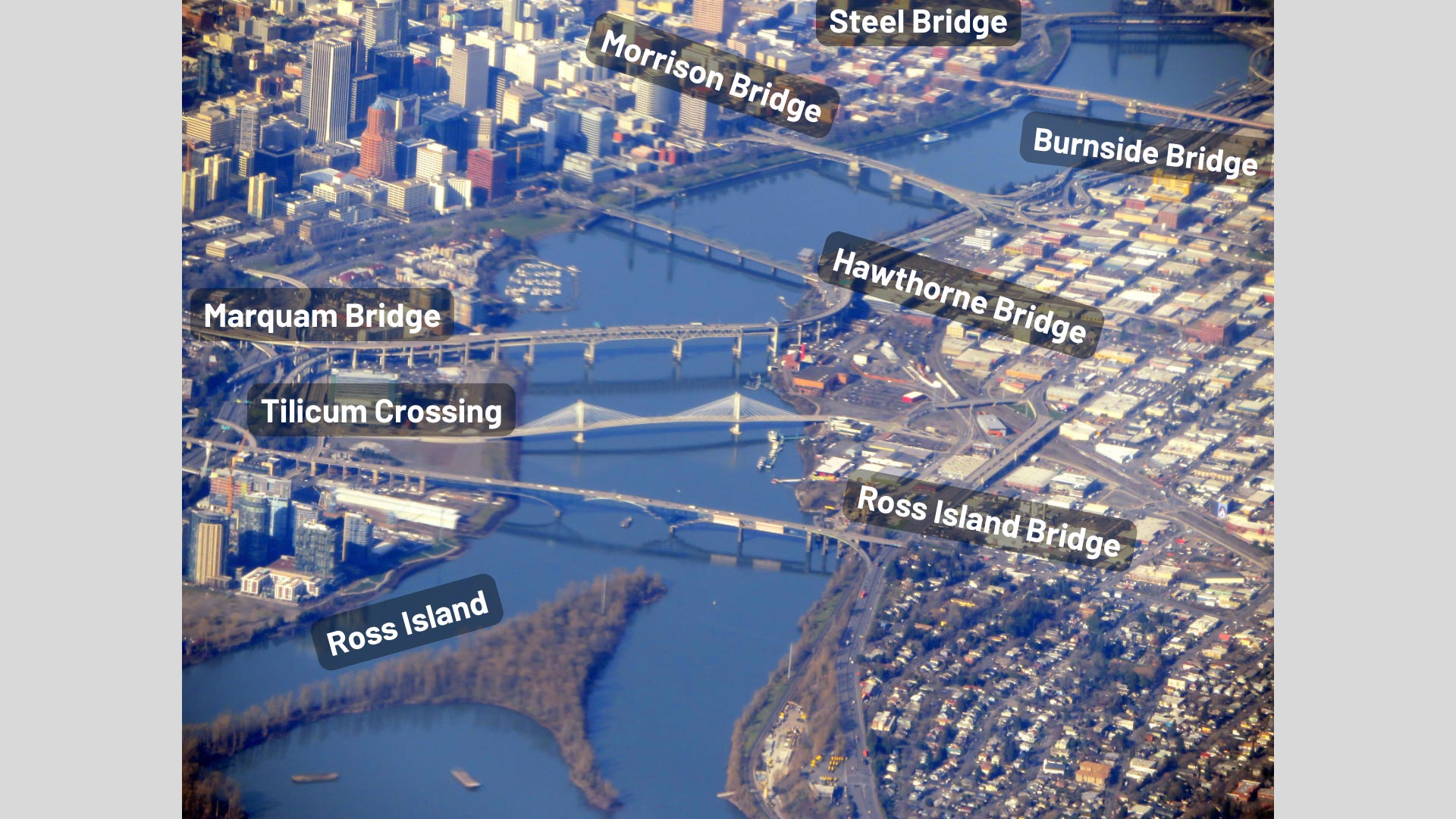
Whose plane was it? I don’t know. Maybe it was his AT-6, or maybe the Mosquito Control Division provided planes? (And did you notice they had a whole division devoted to mosquitoes?)
I put the story to music, or let’s be honest, I bossed Suno around until it made me a song. I’ve written about Suno before. It’s one of several music generators available these days. I wanted something with a 1940s feel and a bit of mischief. I think it’s the clarinet that makes this work. What do you think?
But then, I got to wondering. Could AI help make this into a little music video? I mean, you know, I sort of miss VH1.
Why the pictures are made of paper
I have no photograph of Ozzie’s plane, or the bridge that morning, or two boys hauling their sisters’ clothes down the street.
I could generate a photorealistic scene. I would rather not. The moment a realistic AI image of an ancestor exists, somebody uploads it to Ancestry or FamilySearch and the caption falls off. Then it’s considered evidence.
If you’ve been out on these sites, you’ve probably seen photos misused all over the place. Aunt Edna is out there but she’s under Aunt Susie’s timeline. Or Aunt Edna’s photo is in the right place, but it’s an AI version and she looks like a movie star.
So I favor art that can’t possibly be mistaken for a photograph, and I’ve been noticing an art style that is all the rage right now on YouTube. It’s called paper cutout. Everything in the picture is built from layers of construction paper and cardstock, with the cut edges showing.
Cutout animation itself is about a hundred years old; Lotte Reiniger was making silhouette films with it in the 1920s. The AI version showed up all at once this year, and I can’t tell you who started it.
Nobody is going to upload a paper airplane as a family photograph, so I thought, hey, let’s try it!
And you can try it too. It’s not as hard as it looks.
How to make one
Start with something you have no picture of. The house on the census. The ship. The homestead. The store your great-grandfather ran. Add some details, other objects in the scene that will slowly reveal themselves. You can get AI to help with that.
First: Ask AI to help you create a prompt for the image generator.
Just go to your favorite model and tell it what the picture should show. Ask for a paper cutout image prompt describing one main object and up to three additional objects, a color palette, soft light from one direction with deep shadows between the layers, and plenty of empty space. (I’ll put some sample prompts at the end of the article.)
Next: Take that prompt and paste it into an image generator.
I made mine in Google Flow. You can get there by going to labs.google/fx/tools/flow. Sign in with your ordinary Google account. I checked this on a free account. When I looked in August 2026, it allotted 50 points a day, and the images didn’t seem to use up points. So your limitation will be in how many videos you can generate in a day. And it looks like those points refresh daily, so it’s a use-it-or-lose-it situation.
Here’s the one I made. It depicts Ozzie’s Air Medal. The prompt is at the bottom of this piece.
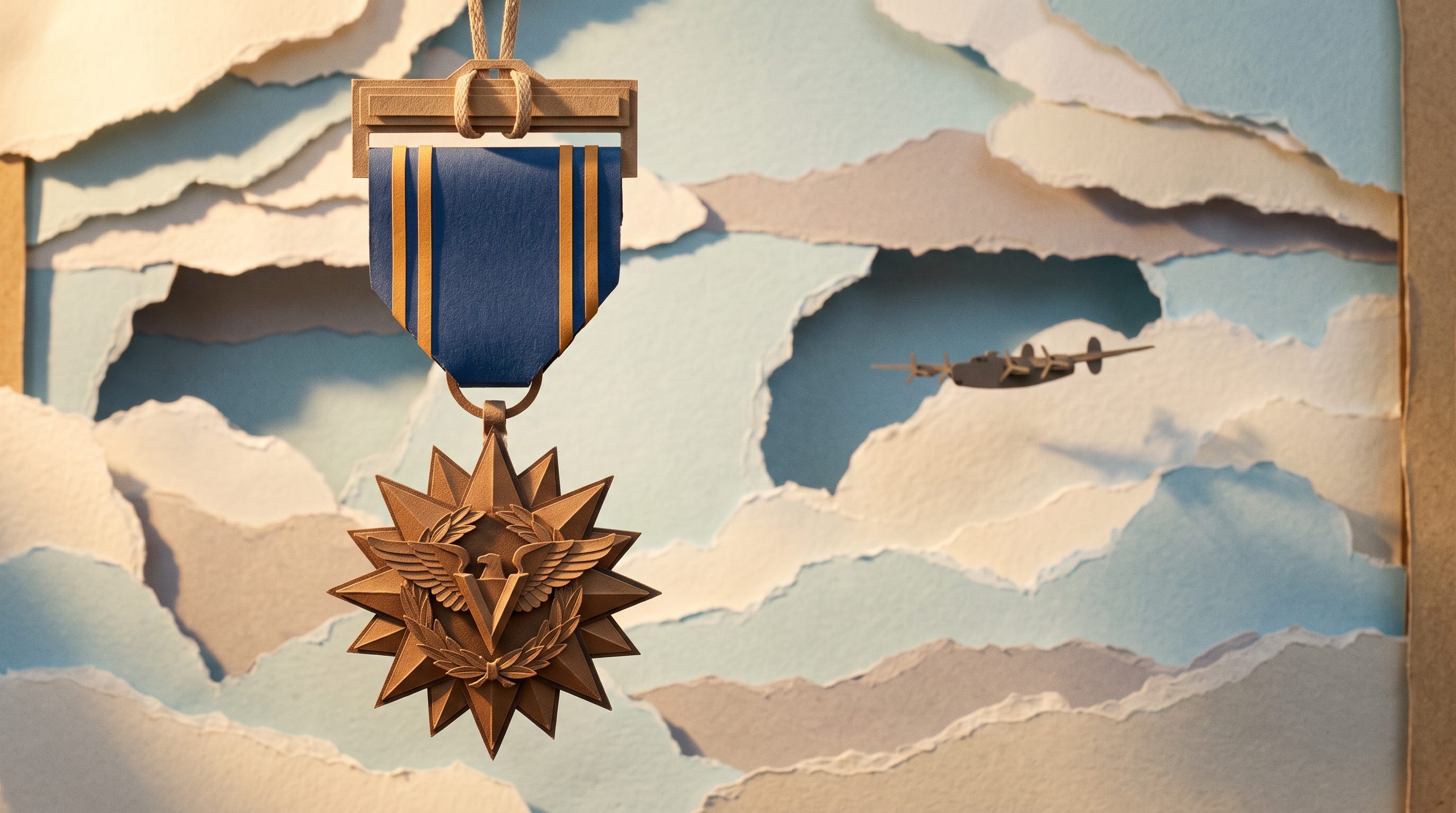
Finally, animate your image.
To animate it, stay in Flow. The video builds the picture in front of you, one paper layer at a time, and then settles. I used their Omni Flash video generator, which uses 15 points. If you have never used Flow, just search YouTube for a quick demo. It is not hard but the menu options can be a little confusing at first.
Animated paper cutout, using Google Flow (Gemini Omni.)
What it’s good for?
OK. I hear those words knocking around in your head. “That’s cute, but I’m a serious historian/genealogist/adult person. What would I do with it?”
I like to text things like this to my kids and grandkids with enough words to explain. For the air medal I might say, “Hey, did you know your 2nd Great Uncle Ozzie got an air medal in World War II? Can you guess the year? First one to answer gets a gold star!” (Only I might not use that much punctuation because teens don’t approve.)
If you have even a very small bit of video editing experience, you might use it in a short explainer video, a music video, or hey, use your imagination!
For my music video, I made a string of these. I asked Claude to create one prompt for each line of the song, then I pasted those prompts into Google Flow.
How long did it take? Hm. I didn’t time myself, because I just do these things in little bits between regular life. But I’m irritatingly slow. Maybe three hours?
Seafair is over. The smoke has cleared a little today. The Blue Angels have gone on to wherever they go next. And my favorite Uncle Ozzie story is still the one about how he flew under the Ross Island Bridge on a Tuesday morning in June.
Can I prove it was really him? I’m working on a video about figuring out how to do that. I’ll let you know when that is finished.
The prompts
The song, in Suno:
Narrative acoustic folk with jazz-influenced harmony, acoustic guitar, upright bass, brushed drums, piano, occasional clarinet, warm conversational male vocals, mid-tempo, nostalgic with quiet humor
What I told Claude first to get my Air Medal Image Prompt:
You are an elite editorial art director, paper engineer, and stop-motion designer. Write one complete papercut image prompt for the scene I describe at the bottom of this message. No preambles, no filler.
The prompt must be fully self-contained and describe: one hero object, a maximum of three supporting objects, a background that matches the scene, a color palette suited to the subject, soft directional lighting with deep shadow gaps between layers, and generous negative space. Every object must be built entirely from thick cardstock, kraft paper, and construction paper, with dozens of individually cut layers, visible paper thickness, exposed cut edges, and handcrafted glue joints. Never show a canvas, board, table, or frame — the entire world itself is made of paper. End the prompt with: premium handcrafted stop-motion paper aesthetic, ultra-detailed, 8K, no text, no logos, no watermark.
Here is my scene:
Second Lieutenant, B-25, Air Medal in ‘45.
That scene was actually just a line from my song. It’s not much to go on, but it worked, because the instructions above it tell AI to create a prompt that adds necessary details as needed. So Claude made up every detail that I didn’t specify in the finished prompt: the blue ribbon, the bronze star, and the sky behind it. You can let your AI make up the details, but you can also be more specific.
So if you were doing an old homestead, you might say:
A one-room sod house on the Nebraska prairie in 1885, with a windmill beside it and open grassland to the horizon.Or for great-grandpa’s store:
A small-town general store with a wooden false front and a covered porch, on a dirt main street in Kansas about 1905.
You can often get details from your source record or family tribal knowledge. Whatever you leave out, the model fills in for you.
The Air Medal image: (This is the prompt that Claude created for me.)
A single military Air Medal filling most of the frame, a bronze sixteen-point star pendant hanging from a broad ribbon in deep blue with narrow gold-orange stripes, suspended against a background of open pale sky with soft layered clouds and a tiny distant bomber silhouette far behind it, in a vintage palette of deep blue, warm bronze, gold, weathered cream and soft cloud grey, composed as a wide cinematic 16:9 scene with generous negative space around the medal, lit by warm directional light from the upper left with deep shadow gaps between every layer. Every object is built entirely from thick cardstock, kraft paper and construction paper, with dozens of individually cut layers, visible paper thickness, exposed cut edges and handcrafted glue joints. Never show a canvas, board, table or frame — the entire world itself is made of paper. premium handcrafted stop-motion paper aesthetic, ultra-detailed, 8K, no text, no logos, no watermark.
The animation prompt. This one is the same every time, for every image:
The camera is completely locked. No zoom, no pan, no tilt, no rotation, no movement of any kind. Over the first seven seconds the scene assembles itself layer by layer from back to front, each cut paper piece sliding into place, settling with a small bounce, and casting a real layered shadow on the layer behind it. For the final three seconds the image becomes a living paper poster with only tiny movements — a slow drift, a soft flutter, a slight sway, light shifting gradually across the paper surfaces. Nothing moves position, nothing scales, nothing enters or leaves the frame. Include handcrafted stop-motion imperfections and subtle paper ASMR sound.
Sources
“Plane Sprays Case of Jitters,” The Oregon Daily Journal (Portland, Oregon), 20 June 1950, page 3; digital image, Newspapers.com.
“Pilot’s Antics Start Worry,” The Oregonian (Portland, Oregon), 21 June 1950, page 9; digital image, Newspapers.com.
“Four Portland Men Awarded Air Medal,” The Oregon Daily Journal (Portland, Oregon), 3 May 1945, page 28; digital image, Newspapers.com.
The Adventures of Prince Achmed (Die Abenteuer des Prinzen Achmed), directed by Lotte Reiniger, 1926 — the oldest surviving animated feature film. Her first silhouette film, The Ornament of the Loving Heart, was made in 1919. https://en.wikipedia.org/wiki/Lotte_Reiniger
AIpreneur, “This FREE Claude Prompt Builds VOX Style Animation Automatically” — the walkthrough I worked from. Note: This is clearly an AI generated voice showing an AI generated video telling humans how to do things with AI. The script was probably AI generated, too. And the audience is people who want to bulk-create “faceless” youtube channels that they hope will get them views and revenue. But if you want to see a very quick demo of Google Flow, you can see it here.
Bridge Photo Credits: User:Pi.1415926535, CC BY-SA 4.0 https://creativecommons.org/licenses/by-sa/4.0, via Wikimedia Commons (I added the bridge labels)
This is so awesome. Thank you for sharing and explaining how you created it.